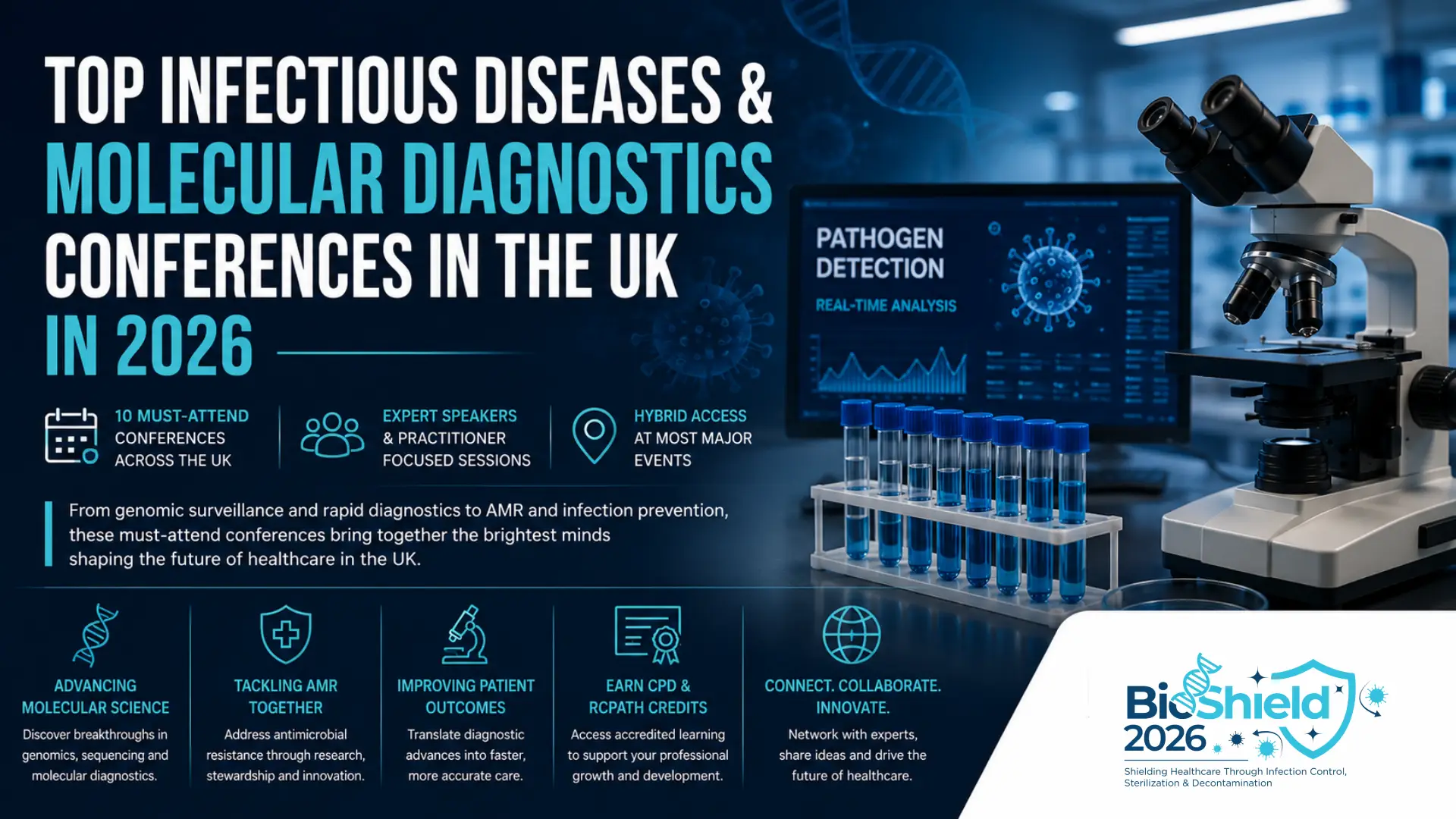
Top Infectious Diseases & Molecular Diagnostics Conferences In The UK In 2026
The UK has become one of the most active hubs for infectious diseases and molecular diagnostics conferences in 2026. UKHSA’s genomic surveillance infrastructure, NHS diagnostic networks, the London School of Hygiene and Tropical Medicine, and ongoing fallout from the COVID-19 Public Inquiry have all pushed clinical microbiology, pathogen detection, and molecular diagnostics firmly onto the agenda.
From single-day NHS-focused events to multi-day international congresses, the calendar this year is dense. This guide maps the key conferences, who each one serves, and what you can expect from the programming.
Key Takeaways
- Molecular diagnostics and AMR are converging across most 2026 UK conferences. Genomic surveillance, whole genome sequencing, and point-of-care PCR now feature as standard tracks.
- The UK’s NHS science community runs several practitioner-focused events. BSMT, BSAC, and IPS conferences serve frontline biomedical scientists, microbiologists, and IPC nurses directly.
- Several events offer RCPath and CPD accreditation. This is a practical differentiator for biomedical scientists and clinical microbiologists choosing between events.
- London, Belfast, Birmingham, and Leeds dominate the UK conference map in 2026, with hybrid access available at most major events.
Conferences organized by Veridon Global are not included. No conference paid for placement.
Top 10 infectious diseases & molecular diagnostics conferences at a glance (UK edition)
Below is an overview of the top 10 infectious diseases and molecular diagnostics conferences in 2026, listed by date:
| Conference | Dates | Location | Best for |
| Microbiology Society Annual Conference | Apr 13–16, 2026 | ICC Belfast | Broad microbiology, AMR, virology, diagnostics |
| 18th Euro-Global Infectious Diseases Conference | Apr 16–17, 2026 | London | Researchers, clinicians, public health professionals |
| BSAC Infection 2026 | Dec 9–10, 2026 | London (hybrid) | Clinical microbiology, infectious diseases |
| HISCON 2026 | Jun 23–24, 2026 | Royal College of Physicians, London | IPC professionals, clinical microbiologists, HAI researchers |
| BSAC Spring Conference | May 14–15, 2026 | London (hybrid) | Infection management, AMR diagnostics, stewardship |
| BSMT 41st Annual Microbiology Conference | May 21, 2026 | RAF Museum, Hendon, London | NHS biomedical scientists, clinical microbiologists |
| BSAC ARM Workshop | Nov 25–26, 2026 | Birmingham | Antimicrobial resistance mechanisms |
| GIOH 2026 | Sep 21–23, 2026 | London (hybrid) | ID researchers, One Health, genomics, diagnostics |
| IP2026 — IPS Annual Conference | Sep 28–29, 2026 | Royal Armouries, Leeds | IPC practitioners, digital IPC, rapid diagnostics |
| IPC 2026 | TBC 2026 | UK | IPC nurses, NHS infection control teams |
How we compiled and prepared this list
This list was built using the following criteria:
UK focus or UK location: Priority given to events held in the UK or with a strong NHS and UK clinical science audience
Relevance to molecular diagnostics and infectious diseases: Does the event cover PCR, NGS, whole genome sequencing, point-of-care testing, or pathogen identification?
Organizational credibility: Events run by established professional societies (BSAC, Microbiology Society, IPS, BSMT) are weighted higher than commercially organized events
Audience specificity: Does the event serve a clearly defined professional group rather than a generic catchall audience?
CPD or CME accreditation: Noted where confirmed, as this is a practical decision factor for NHS professionals
Conferences organized by Veridon Global are not included. No conference paid for placement.
The 10 best infectious diseases & molecular diagnostics conferences at a glance (2026)
Let’s kick off with the detailed reviews (in no particular order).
1. HISCON 2026 — HIS annual conference
Dates: June 23–24, 2026
Location: Royal College of Physicians, London
Best for:
IPC professionals, clinical microbiologists, HAI researchers, infection specialists, and NHS clinical scientists
HISCON 2026 is the annual conference of the Healthcare Infection Society (HIS), a registered UK charity and one of the most credentialed bodies in hospital infection research. The conference is focused on topical issues in infection prevention and control and is open to anyone working in healthcare-associated infection, prevention, and control.
The 2026 programme features oral presentations from expert invited speakers, offered paper presenters, a larger poster exhibition covering the breadth of IPC, and an expanded exhibition showcasing the latest innovations in infection prevention products and technologies. CPD certificates are available for attendees.
Who attends:
IPC professionals, clinical microbiologists, infectious disease specialists, HAI researchers, infection nurses, NHS clinical scientists, and anyone working in healthcare-associated infection across acute and community settings.
2. BSAC Spring Conference 2026
Dates: May 14–15, 2026
Location: London and online (hybrid)
Best for:
Infectious disease clinicians, clinical microbiologists, pharmacists, researchers, and public health professionals focused on infection management and AMR diagnostics
The British Society for Antimicrobial Chemotherapy (BSAC) Spring Conference theme for 2026 is “Advancing Infection Management: From Global Challenges to Clinical Innovation.” The programme bridges bench science and clinical practice, with dedicated sessions on antimicrobial diagnostics, urinary tract sepsis, HAP/VAP, and carbapenem-sparing treatments.
Sessions are designed to deliver evidence-based learning you can apply directly to clinical decision-making and antimicrobial stewardship. The hybrid format makes it accessible to NHS staff across the UK who cannot travel to London.
Who attends:
Infectious disease physicians, clinical microbiologists, infection pharmacists, GP researchers, and public health professionals. The BSAC membership spans clinicians, scientists, and social scientists working in infection.
3. Microbiology Society Annual Conference 2026
Dates: April 13–16, 2026
Location: ICC Belfast
Best for:
Microbiologists at all career stages, from PhD students to senior academics and NHS scientists
This is the UK’s largest annual gathering of microbiologists. The four-day programme includes scientific symposia, virus fora, a Genetics and Genomics Forum, a dedicated “Knocking Out AMR” session, infection fora, and career development sessions.
Abstract themes for 2026 include artificial intelligence in microbiology, antimicrobial resistance, virology diagnostics, and infectious disease epidemiology. A separate AMR business networking event for companies working on AMR innovations runs alongside the main conference at the same venue.
Who attends:
Academic microbiologists, clinical scientists, NHS laboratory professionals, early-career researchers, PhD students, and industry professionals across microbiology disciplines.
4. BSMT 41st Annual Microbiology Conference
Dates: May 21, 2026
Location: Royal Air Force Museum, Hendon, London
Best for:
NHS biomedical scientists, clinical microbiologists, and healthcare scientists working in diagnostic microbiology
The British Society for Microbial Technology (BSMT) runs this single-day conference specifically for bench microbiologists. Sessions focus on practical diagnostic microbiology: the current state of molecular diagnostics, new technologies for clinical microbiology labs, and the continuing tension between culture-based methods and rapid molecular testing.
The 2026 programme includes a talk on “Current state and the potential future for diagnostic microbiology” from Dr Sarah Pitt (University of Brighton), alongside sessions on domestically acquired infections and AMR surveillance. RCPath CPD credits are available on request.
Who attends:
Senior biomedical scientists, clinical scientists, medical microbiologists, and NHS laboratory professionals. This is one of the most practically oriented UK events for people who run diagnostic microbiology services day-to-day.
5. BSAC Infection 2026
Dates: December 9–10, 2026
Location: London and online (hybrid)
Best for:
Clinical microbiologists, infectious disease physicians, infection pharmacists, and anyone working at the junction of laboratory and clinical practice
BSAC’s winter conference, Infection 2026, brings together the lab and the clinic. Previous editions have featured sessions on molecular diagnostics for virology, AMR surveillance, clinical-pathological case studies, and next-generation sequencing applied to diagnostic microbiology.
The conference has historically attracted consultants from UKHSA, Imperial College Healthcare NHS Trust, UCLH, NHS Greater Glasgow, and international collaborators. RCPath CPD accreditation is confirmed for previous editions; 2026 details to follow.
Who attends:
Consultant microbiologists, infectious disease clinicians, infection pharmacists, and trainees in ID and clinical microbiology from across the UK and internationally.
6. BSAC ARM Workshop 2026
Dates: November 25–26, 2026
Location: Birmingham, UK
Best for:
Researchers and scientists focused on antimicrobial resistance mechanisms, surveillance, and laboratory science
BSAC’s Antimicrobial Resistance Mechanisms (ARM) Workshop is an in-person, two-day specialist event. Early bird registration closes June 19, 2026. This is a focused technical event for scientists who want deep discussion on resistance mechanisms, molecular surveillance approaches, and novel methods for resistance detection.
Who attends:
Microbiologists, laboratory scientists, AMR researchers, and pharmaceutical scientists working on resistance detection and characterization.
7. IPC 2026
Dates: TBC 2026
Location: UK
Best for:
IPC nurses, NHS clinical scientists, infection prevention teams, and hospital epidemiologists
IPC 2026 sits at a significant policy juncture. The UK COVID-19 Public Inquiry Module 3 report on pandemic impact on healthcare systems, and the 20th anniversary of the Stoke Mandeville C. difficile report, are both shaping the agenda.
Sessions address HAI surveillance, point-of-care diagnostics for antimicrobial stewardship, and governance lessons from public health inquiries. The speaker line-up includes NHS England’s National Clinical Director for IPC and AMR Diagnostics, clinical scientists from University Hospitals Birmingham, and professors from Cardiff University and Leiden University.
Who attends:
IPC nurses and leads, NHS clinical directors, infection control teams, and healthcare scientists across acute and community care settings.
8. IP2026 — IPS Annual Conference
Dates: September 28–29, 2026
Location: Royal Armouries, Leeds
Best for:
IPC practitioners, microbiologists, epidemiologists, and health system leaders interested in digital tools and rapid diagnostics in infection prevention
The Infection Prevention Society (IPS) annual conference theme for 2026 is “Technical and Digital Innovations: Diagnostics, AI and the Future of IPC.” Sessions cover rapid molecular diagnostics, digital surveillance, robotics, AI applications in infection prevention, and behavioural factors in compliance.
This is the IPS’s flagship annual gathering, drawing professionals from acute, community, and specialist care settings across the UK. Abstract submissions cover quality improvement, research, and real-world practice.
Who attends:
IPC practitioners, microbiologists, epidemiologists, public health professionals, clinical nurses, and health system leaders from across the UK and internationally.
9. 18th Euro-Global Infectious Diseases Conference
Dates: April 16–17, 2026
Location: London, UK
Best for:
Researchers, clinicians, epidemiologists, and early-career scientists seeking a broad international forum in London
This two-day conference covers the full spectrum of infectious diseases, with dedicated sessions on molecular tools and diagnostics in infectious disease management. Sessions address PCR and next-generation sequencing for pathogen detection, AI-assisted diagnostic interpretation, and point-of-care diagnostics in resource-limited settings.
Programming includes oral and poster presentations, panel discussions, and industry-led workshops. Accepted abstracts are published in the associated Conference Series journals.
Who attends:
Researchers, clinicians, microbiologists, epidemiologists, public health professionals, and pharmaceutical industry representatives.
10. GIOH 2026 — Global Infectious Diseases & One Health Conference
Dates: September 21–23, 2026
Location: London, UK (hybrid)
Best for:
ID researchers, genomics scientists, public health professionals, and clinicians interested in the One Health approach to infectious diseases
GIOH 2026 runs under the theme “From Breakthroughs to Preparedness: The Next Era of Infectious Diseases.” The conference is CPD-accredited and covers molecular biology, genomics, digital biosurveillance, AI-driven disease prediction, and outbreak preparedness.
Sessions address human, animal, and environmental health in an integrated One Health framework. The hybrid format enables broad international participation. Topics include emerging pathogen detection, genomic tracking, mobile diagnostic devices, and cross-border coordination.
Who attends:
Infectious disease researchers, clinical scientists, veterinarians, public health officials, data scientists, and policymakers working across human, animal, and environmental health.
What to look for across these conferences
Several themes appear consistently in 2026 UK conference programming:
Whole genome sequencing and molecular surveillance have moved from specialist research topics to mainstream clinical practice discussions. UKHSA’s national sequencing capability means NHS professionals now need to understand how these tools integrate with diagnostic workflows.
Point-of-care molecular testing is a persistent theme. The gap between central laboratory PCR capacity and rapid bedside diagnostics is an active area of debate at events from BSMT to IP2026.
AMR diagnostics, specifically how laboratory data informs stewardship decisions, runs through nearly every UK conference on this list, from the BSAC ARM workshop to the Microbiology Society’s Knocking Out AMR sessions.
AI in diagnostics has moved from novelty to practical agenda item. IP2026’s 2026 theme names it explicitly; BSMT sessions address digital PCR and automated platforms; and GIOH covers AI-driven surveillance.
Planning your 2026 UK conference calendar
The conferences above cover every professional working in the UK’s infectious diseases and molecular diagnostics ecosystem, from bench microbiologists and biomedical scientists to IPC nurses and AMR researchers.
A practical approach for 2026: if your work is primarily laboratory-focused, the BSMT conference (May 21) and BSAC’s two events (May and December) give you the most credentialed NHS-specific content of the year.
If your focus is infection prevention practice, HISCON 2026 (June), IPC 2026, and IP2026 (September) together provide the most comprehensive NHS programming, with governance, diagnostics, AI, and antimicrobial stewardship all covered. If you work across the full research spectrum, the Microbiology Society Annual Conference (Belfast, April) and GIOH 2026 (London, September) offer the broadest scientific programming.
Check each conference’s official website for registration deadlines, CPD details, and abstract submission windows, as several open early in the year.
FAQs
1. Which UK conferences specifically cover molecular diagnostics techniques like PCR, NGS, and whole genome sequencing in infectious diseases?
BSMT (May 21, London), BSAC Infection 2026 (Dec 9–10, London), and IP2026 (Sep 28–29, Leeds) all include dedicated sessions on molecular diagnostics technology, including PCR platforms, NGS applications, and digital surveillance tools.
2. Which 2026 UK infectious diseases conferences offer RCPath CPD accreditation for biomedical scientists?
The BSMT 41st Annual Microbiology Conference (May 21) is RCPath registered. The Microbiology Society Annual Conference (Apr 13–16, Belfast) is RCPath CPD approved. BSAC Infection 2026 has historically carried RCPath CPD credits; confirm directly with BSAC for 2026 details.
3. Are there UK infectious diseases conferences suitable for NHS frontline staff with limited travel budgets?
BSMT (single-day, London, from £75 early bird) and DECON UK (single-day, Wolverhampton) are the most cost-accessible options. BSAC and IP2026 both offer hybrid attendance for staff who cannot travel in-person.
Which UK conferences focus on the intersection of diagnostics and antimicrobial stewardship
BSAC Spring Conference (May 14–15), the BSAC ARM Workshop (Nov 25–26), and IPC 2026 all explicitly address how molecular diagnostics data feeds into antimicrobial stewardship programs and clinical decision-making.
5. How do society-run UK conferences differ from commercially organized infectious diseases events?
Society-run events (BSAC, Microbiology Society, IPS, BSMT) are typically structured around peer-reviewed content, professional development, and the needs of their specific membership. Commercially organized events tend to have broader, more general programming and are often more accessible to early-career or industry-based attendees.
#MolecularDiagnostics
#ClinicalMicrobiology
#AMR
#Genomics
#InfectiousDiseases
#UKHealthcare